News & Blog
Introduction to PGDEMS Course
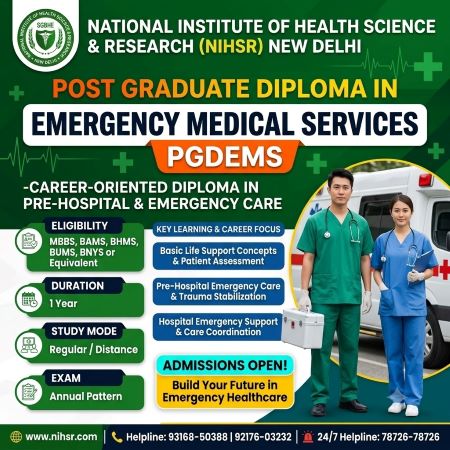
The Post Graduate Diploma in Emergency Medical Services (PGDEMS) is a postgraduate-level diploma course designed to develop knowledge and practical understanding of emergency medical services, emergency response systems, pre-hospital care, and patient management during medical emergencies.
The course focuses on the principles of emergency care, patient assessment, coordination during emergencies, basic life support concepts, and the role of healthcare professionals in emergency medical situations. It is intended for eligible candidates with a background in medicine or an equivalent qualification who wish to enhance their knowledge of emergency medical services.
The National Institute of Health Science & Research (NIHSR) provides course information and educational opportunities for eligible candidates interested in this field.
PGDEMS Course Details
The basic details of the Post Graduate Diploma in Emergency Medical Services are provided below.
|
Particulars |
Details |
|
Course Name |
Post Graduate Diploma in Emergency Medical Services |
|
Course Abbreviation |
PGDEMS |
|
Eligibility |
MBBS, BAMS, BHMS, BUMS, BNYS or Equivalent |
|
Duration |
1 Year |
|
Study Mode |
Regular / Distance |
|
Examination Pattern |
Annual |
|
Institute |
National Institute of Health Science & Research (NIHSR) |
|
Official Website |
Note: Admission eligibility, study mode, practical requirements, and applicable course conditions are subject to the institute's current admission guidelines.
PGDEMS Eligibility Criteria
Candidates interested in the PGDEMS course should possess a relevant medical qualification as specified by the institute.
The prescribed eligibility includes:
- MBBS (Bachelor of Medicine and Bachelor of Surgery)
- BAMS (Bachelor of Ayurvedic Medicine and Surgery)
- BHMS (Bachelor of Homeopathic Medicine and Surgery)
- BUMS (Bachelor of Unani Medicine and Surgery)
- BNYS (Bachelor of Naturopathy and Yogic Sciences)
- An equivalent qualification, subject to verification and acceptance by the institute
Applicants should submit their educational qualification documents for verification during the admission process. Acceptance of an equivalent qualification will depend on the applicable admission requirements.
Important: Eligibility for admission to PGDEMS does not, by itself, confer any additional statutory registration, professional licence, or authorization to practise medicine or undertake regulated emergency medical procedures.
PGDEMS Course Duration
The duration of the Post Graduate Diploma in Emergency Medical Services is 1 year.
During this period, candidates may study subjects and concepts related to emergency medical services, patient assessment, emergency response, and coordination of care. The actual curriculum, academic schedule, and assessment requirements should be confirmed through the institute's current course syllabus and guidelines.
Candidates should also confirm any prescribed practical training, clinical exposure, attendance, or internship requirements, where applicable.
Study Mode: Regular and Distance
The PGDEMS course is offered in Regular / Distance mode as specified in the institute's course information.
1. Regular Mode
Regular mode is intended for candidates who prefer a structured academic schedule with classroom-based learning and any practical or training components prescribed by the institute.
Candidates should confirm the availability of practical sessions, training facilities, attendance requirements, and clinical exposure before admission.
2. Distance Mode
Distance mode is intended for eligible candidates who require a more flexible study arrangement.
Before enrolling, candidates should verify the prescribed learning process, examination arrangements, practical requirements, and any mandatory in-person training. Distance learning should not be assumed to replace practical competencies or supervised clinical training required for particular professional activities.
Subjects and Learning Areas in Emergency Medical Services
The exact subjects and syllabus should be obtained from the institute's current curriculum. Relevant academic learning areas may include:
- Introduction to Emergency Medical Services: Overview of emergency response systems and the organization of emergency care.
- Emergency Patient Assessment: Initial assessment, recognition of urgent conditions, and prioritization of care.
- Basic Life Support Concepts: Principles of cardiopulmonary resuscitation and immediate response to life-threatening emergencies, with practical competency requirements where prescribed.
- Pre-Hospital Emergency Care: Understanding the initial management and safe transfer of patients before arrival at a healthcare facility.
- Trauma and Accident Emergencies: Introduction to trauma assessment, emergency coordination, and patient stabilization principles.
- Medical Emergencies: Recognition of common acute medical conditions and the importance of timely referral and escalation.
- Emergency Communication and Coordination: Communication among emergency responders, healthcare teams, and receiving facilities.
- Patient Safety and Documentation: Safe patient handling, confidentiality, record keeping, and professional responsibilities.
These are illustrative learning areas and should not be treated as the institute's confirmed subject list unless included in its official syllabus.
Career Opportunities After PGDEMS
Emergency medical services are an important part of healthcare delivery. Knowledge of emergency response and patient coordination may be relevant to several healthcare-related settings, depending on a candidate's existing qualification, practical competencies, experience, and applicable professional requirements.
Potential areas of work may include:
- Emergency care coordination
- Hospital emergency department support
- Ambulance service coordination
- Pre-hospital care support, within the person's authorized scope
- Emergency response programme support
- Patient transfer and referral coordination
- Healthcare operations and emergency preparedness
- Training or administrative support in emergency medical services, where qualified
Career clarification: Completion of PGDEMS does not automatically guarantee employment, a particular salary, independent clinical practice, or eligibility for a regulated post. Employers may require additional qualifications, recognized credentials, clinical experience, practical certifications, or registration with the relevant authority.
Skills Relevant to Emergency Medical Services
Candidates studying emergency medical services may develop or strengthen the following skills through appropriate theoretical learning and supervised practical training:
- Understanding emergency response protocols.
- Recognizing situations requiring urgent medical attention.
- Communicating clearly during emergency situations.
- Understanding patient assessment and referral processes.
- Coordinating with healthcare teams and emergency service personnel.
- Maintaining patient records and following safety procedures.
- Understanding professional ethics, confidentiality, and the limits of one's role.
Practical skills must be developed and assessed through appropriate training wherever required. Candidates should perform only those procedures for which they are adequately trained and legally authorized.
PGDEMS Admission Process at NIHSR
Candidates interested in the Post Graduate Diploma in Emergency Medical Services may follow these general admission steps:
- Step 1: Review Eligibility – Check whether your MBBS, BAMS, BHMS, BUMS, BNYS, or equivalent qualification meets the institute's current admission criteria.
- Step 2: Contact the Institute – Contact NIHSR to obtain the latest course prospectus, syllabus, fee details, study-mode conditions, and admission requirements.
- Step 3: Submit the Application – Complete the prescribed application process and provide the required academic and personal documents.
- Step 4: Qualification Verification – Submit the relevant qualification certificates and other documents for verification by the institute.
- Step 5: Confirm Course Requirements – Before completing admission, confirm the course duration, examination pattern, practical or training requirements, applicable fees, and certificate conditions.
- Step 6: Complete the Admission Formalities – Proceed with admission after receiving the applicable course information and confirmation from the institute.
Admission is subject to verification of eligibility and compliance with the institute's applicable rules.
Why Consider NIHSR for PGDEMS?
The National Institute of Health Science & Research (NIHSR) provides educational information and course opportunities in healthcare-related fields.
Candidates considering PGDEMS should review the course syllabus, academic requirements, available study mode, assessment procedures, and relevant documentation before making an admission decision.
NIHSR encourages candidates to understand the scope and limitations of their chosen course and to verify any additional professional requirements relevant to their intended career.
Frequently Asked Questions (FAQs)
1. What is the full form of PGDEMS?
PGDEMS stands for Post Graduate Diploma in Emergency Medical Services.
2. What is the eligibility for PGDEMS?
The prescribed eligibility includes MBBS, BAMS, BHMS, BUMS, BNYS, or an equivalent qualification accepted by the institute.
3. What is the duration of the PGDEMS course?
The course duration is 1 year, subject to the institute's applicable academic requirements.
4. Is PGDEMS available in Regular and Distance mode?
The course is listed in Regular / Distance mode. Candidates should confirm current availability, practical requirements, and the conditions applicable to their preferred mode before admission.
5. What is the examination pattern for PGDEMS?
The course follows an annual examination pattern as specified in the course details. Candidates should obtain the current examination scheme from the institute.
6. What can candidates do after completing PGDEMS?
Depending on their prior qualification, skills, experience, and applicable requirements, candidates may explore relevant emergency medical services, healthcare coordination, and support roles. Employment and professional authorization are not guaranteed by the diploma alone.
7. Does PGDEMS automatically authorize independent medical practice?
No. Admission to or completion of this diploma does not automatically grant a medical licence, statutory registration, or independent practice rights. Candidates must comply with the requirements of the relevant professional and regulatory authorities.
8. Where can I get more information about PGDEMS admission?
Visit the official NIHSR website at www.nihsr.com or contact the institute through its official communication channels for the latest prospectus and admission details.
Contact NIHSR for PGDEMS Course Details
National Institute of Health Science & Research (NIHSR)
- Head Office: Aman Nagar, Behind Green Land School, Near Jalandhar Bye Pass, Ludhiana – 141008, Punjab, India.
- Website: www.nihsr.com
- Helpline: 93168-50388 / 92176-03232
- 24/7 Helpline: 78726-78726
Candidates are advised to obtain the current prospectus and confirm all admission conditions before enrolling.
Conclusion
The Post Graduate Diploma in Emergency Medical Services (PGDEMS) is a 1-year diploma course intended for eligible candidates with a medical or equivalent educational background who wish to study emergency response systems, patient assessment, and emergency care coordination.
Before applying, candidates should verify the current eligibility criteria, syllabus, Regular / Distance mode availability, practical training requirements, examination scheme, and applicable professional conditions.
For course information and admission guidance, visit www.nihsr.com.
Disclaimer: NIHSR is an autonomous institution registered under the Societies Registration Act, 1860. All courses are conducted for skill development, vocational education and self-employment purposes only. The institute does not guarantee Government employment, statutory registration, professional licence or recognition by any regulatory authority.
*************************************************************
For More Information.............
National Institute of Health Science & Research
Phone: +91-161-5013232,
Mobile: +91-92176-03232, +91-93168-50388.
Email: nihsr_2001@yahoo.com
24/7 Helpline No. 78726-78726